
Intraoperative Neurophysiological Monitoring (IONM)
Real-time monitoring to reduce neurological risk during complex surgery.
Intraoperative Neurophysiological Monitoring (IONM)
What is Intraoperative Neurophysiological Monitoring?
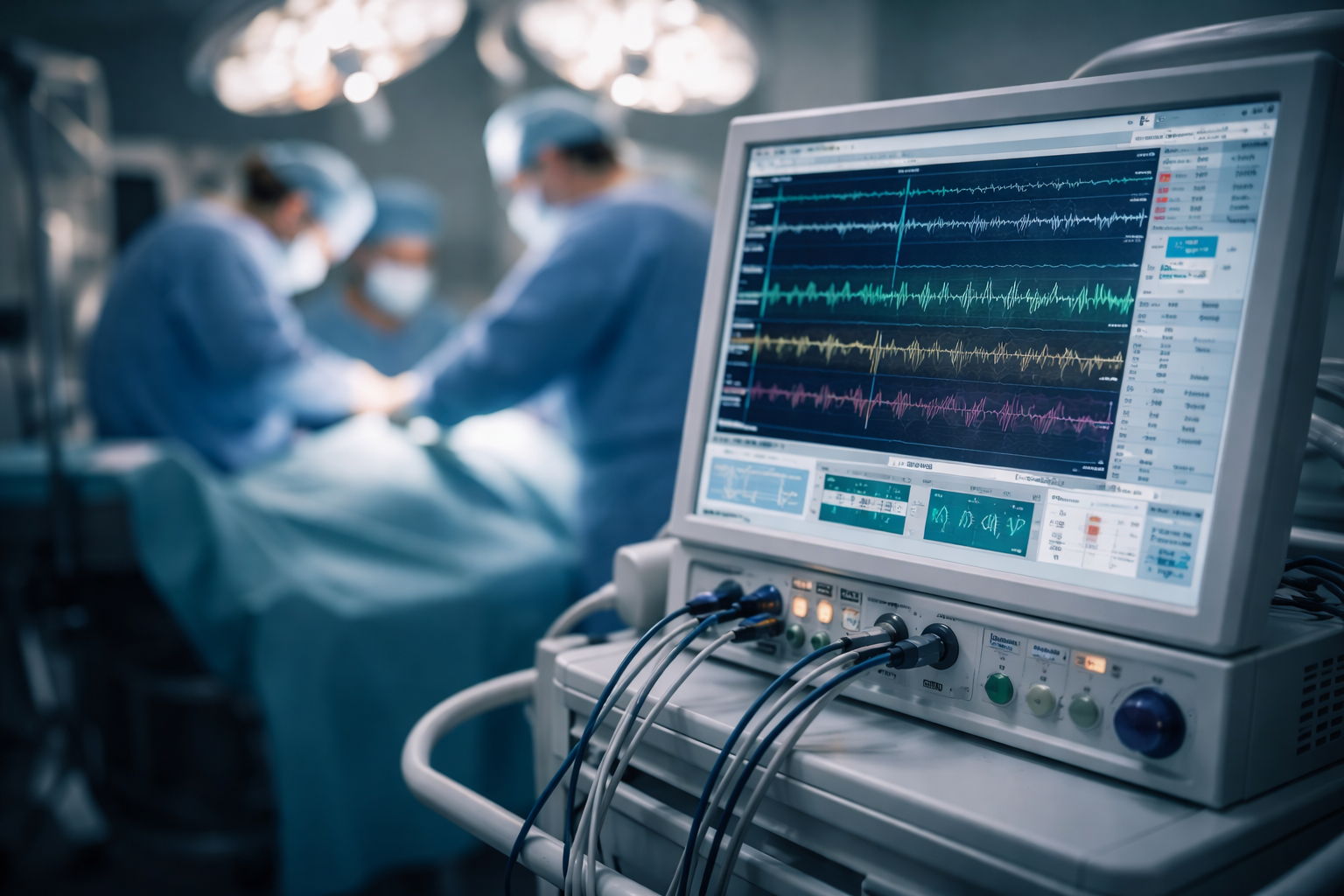
Intraoperative Neurophysiological Monitoring (IONM) involves continuous assessment of neural pathway function during surgery.
Using specialist monitoring techniques, we assess the integrity of the spinal cord, brain, cranial nerves, and peripheral nerves in real time. This allows the surgical team to identify potential neurological compromise immediately and adjust accordingly.
IONM supports risk reduction in procedures where neural structures may be vulnerable.
Surgical specialties supported
Our IONM service supports a range of complex procedures, including:
- Spinal surgery (deformity correction, tumour resection, instrumentation)
- Neurosurgery (intracranial and skull base procedures)
- Orthopaedic surgery involving neural risk
- ENT and head & neck surgery
- Peripheral nerve procedures
Monitoring strategies are tailored to the surgical indication and agreed in advance with the operating consultant.
What is Intraoperative Neurophysiological Monitoring?
Intraoperative Neurophysiological Monitoring (IONM) involves continuous assessment of neural pathway function during surgery.
Using specialist monitoring techniques, we assess the integrity of the spinal cord, brain, cranial nerves, and peripheral nerves in real time. This allows the surgical team to identify potential neurological compromise immediately and adjust accordingly.
IONM supports risk reduction in procedures where neural structures may be vulnerable.
Surgical specialties supported
Our IONM service supports a range of complex procedures, including:
- Spinal surgery (deformity correction, tumour resection, instrumentation)
- Neurosurgery (intracranial and skull base procedures)
- Orthopaedic surgery involving neural risk
- ENT and head & neck surgery
- Peripheral nerve procedures
Monitoring strategies are tailored to the surgical indication and agreed in advance with the operating consultant.
Monitoring we provide
Free-run EMG
Continuous monitoring of spontaneous muscle activity to detect nerve irritation or injury during surgery.
Brainstem Mapping (including posterior fossa procedures)
Intraoperative monitoring of cranial nerve pathways to reduce the risk of neurological injury during brainstem and posterior fossa surgery.
Triggered EMG
Electrical stimulation used to confirm nerve identity and assess proximity to neural structures during surgical procedures.
SSEP and MEP Monitoring During Spine Surgery
Continuous monitoring of sensory and motor pathways to detect spinal cord compromise during spinal procedures.
Cortical and Subcortical Mapping
Functional mapping used to identify and preserve critical brain pathways during tumour or epilepsy surgery.
Eloquent Area / Speech Mapping
Functional mapping used to identify critical language and cognitive areas of the brain to help preserve speech and neurological function during surgery.
Monitoring we provide
Free-run EMG
Continuous monitoring of spontaneous muscle activity to detect nerve irritation or injury during surgery.
Triggered EMG
Electrical stimulation used to confirm nerve identity and assess proximity to neural structures during surgical procedures.
Cortical and Subcortical Mapping
Functional mapping used to identify and preserve critical brain pathways during tumour or epilepsy surgery.
Brainstem Mapping (including posterior fossa procedures)
Intraoperative monitoring of cranial nerve pathways to reduce the risk of neurological injury during brainstem and posterior fossa surgery.
SSEP and MEP Monitoring During Spine Surgery
Continuous monitoring of sensory and motor pathways to detect spinal cord compromise during spinal procedures.
Eloquent Area / Speech Mapping
Functional mapping used to identify critical language and cognitive areas of the brain to help preserve speech and neurological function during surgery.
How we deliver IONM
Structured, consultant-led, and fully integrated with surgical teams.
01 Pre-operative planning
We review the surgical plan, agree the monitoring strategy, and confirm modalities in advance. Governance, documentation, and reporting pathways are aligned prior to theatre.
02 Intraoperative monitoring
Real-time monitoring is delivered throughout the procedure by experienced clinical neurophysiology professionals. Significant changes are communicated immediately to support rapid intraoperative decision-making.
03 Reporting & integration
A formal report is produced following the procedure and shared securely. Findings are integrated into NHS-aligned workflows to support governance, audit, and post-operative planning.
How we deliver IONM
Structured, consultant-led, and fully integrated with surgical teams.
01 Pre-operative planning
We review the surgical plan, agree the monitoring strategy, and confirm modalities in advance. Governance, documentation, and reporting pathways are aligned prior to theatre.
02 Intraoperative monitoring
Real-time monitoring is delivered throughout the procedure by experienced clinical neurophysiology professionals. Significant changes are communicated immediately to support rapid intraoperative decision-making.
03 Reporting & integration
A formal report is produced following the procedure and shared securely. Findings are integrated into NHS-aligned workflows to support governance, audit, and post-operative planning.
Clinical governance & integration
- CQC-registered provider
- Operates via secure HSCN connectivity
- NHS-aligned reporting standards
- Consultant-led oversight
- Rapid deployment capability
Our service integrates seamlessly into both NHS and private hospital pathways.
FAQs
Which monitoring modalities are used during IONM?
Modalities are selected based on the surgical procedure and may include somatosensory evoked potentials (SSEPs), motor evoked potentials (MEPs), electromyography (EMG), and other specialised techniques.
Is IONM available for urgent cases?
Where capacity allows, we offer rapid deployment for urgent or complex surgical cases. Please contact the team to discuss requirements.
Do you integrate with NHS governance systems?
Yes. We operate via HSCN connectivity and provide secure, NHS-aligned reporting compliant with established governance standards.
Who performs the monitoring?
Monitoring is delivered by experienced clinical neurophysiology professionals, with consultant-level oversight and structured reporting processes.
Clinical governance & integration
- CQC-registered provider
- Operates via secure HSCN connectivity
- NHS-aligned reporting standards
- Consultant-led oversight
- Rapid deployment capability
Our service integrates seamlessly into both NHS and private hospital pathways.
FAQs
Which monitoring modalities are used during IONM?
Modalities are selected based on the surgical procedure and may include somatosensory evoked potentials (SSEPs), motor evoked potentials (MEPs), electromyography (EMG), and other specialised techniques.
Is IONM available for urgent cases?
Where capacity allows, we offer rapid deployment for urgent or complex surgical cases. Please contact the team to discuss requirements.
Do you integrate with NHS governance systems?
Yes. We operate via HSCN connectivity and provide secure, NHS-aligned reporting compliant with established governance standards.
Who performs the monitoring?
Monitoring is delivered by experienced clinical neurophysiology professionals, with consultant-level oversight and structured reporting processes.